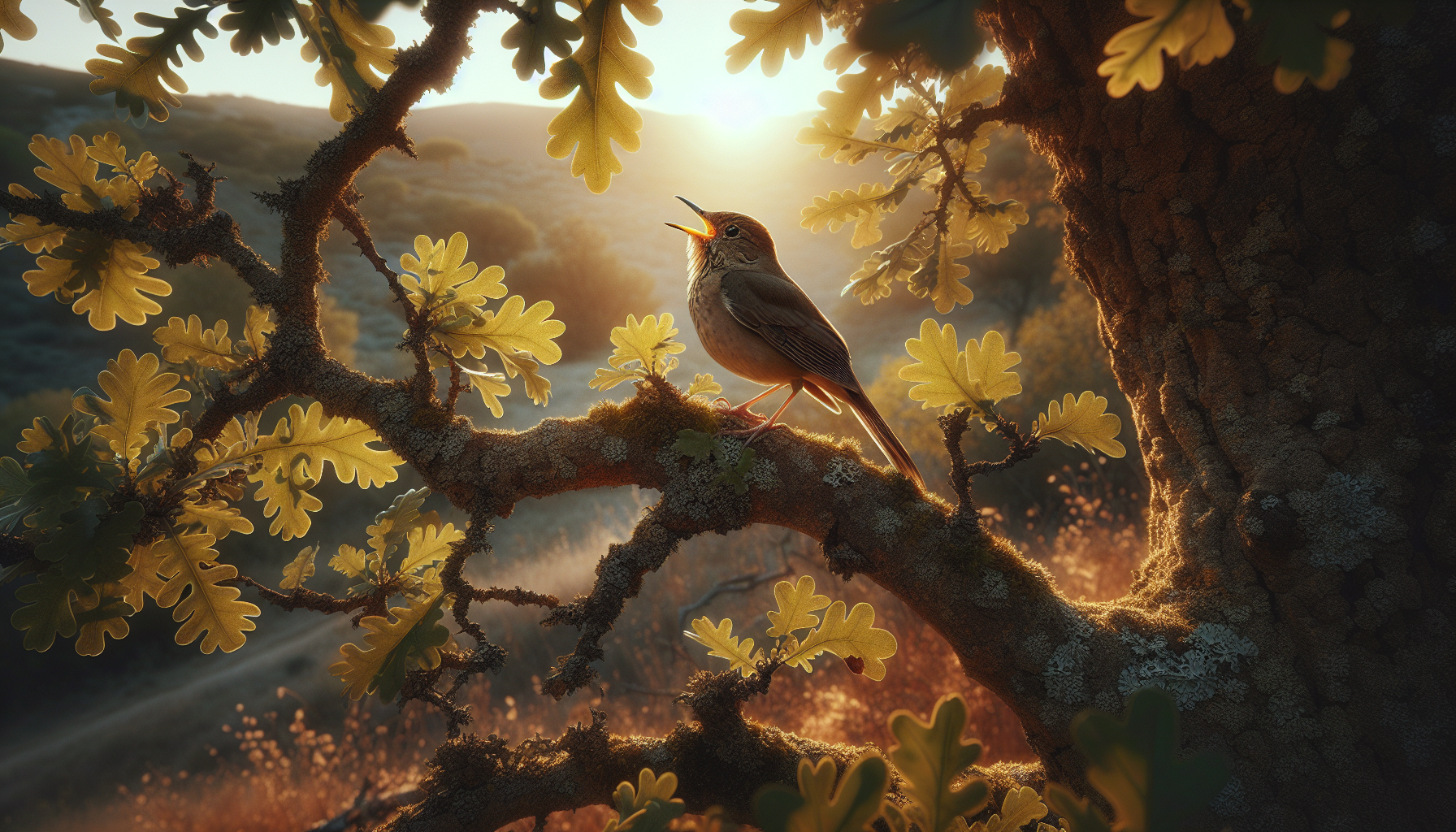
With the arrival of April, the common nightingale (Luscinia megarhynchos) returns to the dehesas of Extremadura, especially in Cáceres, after spending the winter in sub-Saharan Africa. This return marks the beginning of a season in which its song becomes the soul of the region's soundscape. It is not only an indicator of the changing season but also an opportunity to study its acoustic behavior in a habitat as rich as the dehesas.
The nightingale, known for its melodious and complex song, uses its voice to establish territories and court females. This acoustic ritual is essential for the dehesa ecosystem, where holm oaks (Quercus ilex*) and cork oaks (*Quercus suber) provide the perfect environment for its development. The interaction of the nightingale with its surroundings reflects the symbiosis between local fauna and flora, where each song contributes to the ecological balance.
The common nightingale is distinguished by its ability to sing both day and night, although it is during dawn and dusk that its song resonates most clearly. This is due to the decrease in ambient noise during these hours, allowing its song to be heard from greater distances. The nightingale's diet, based on insects and other invertebrates, makes it a natural ally in pest control, highlighting its role in the biodiversity of the dehesa.
The song of the nightingale is a multifunctional tool: in addition to attracting females, it serves to mark territory and warn other males. During this time, males are especially active, performing short flights and complex vocal displays that are part of their courtship ritual. This behavior not only has a reproductive function but also demonstrates the vitality and health of the individual, factors that are evaluated by females.
For nature lovers and ornithologists, the dehesas of Cáceres, particularly the areas near Malpartida de Cáceres, offer a privileged setting for observing the common nightingale. The best moments to hear its song are at dawn and dusk, when conditions are ideal for acoustic recording.
The paths that traverse the dehesas, especially those close to the Monfragüe Natural Park, are ideal for observation. It is essential to respect the park's conservation rules, avoiding the use of song recordings to attract birds, as this could alter their natural and territorial behavior.
The presence of the common nightingale in the dehesas of Cáceres not only enriches the environment with its song but also offers a unique opportunity to study the complex communication systems of birds. Its interaction with the dehesa ecosystem underscores the importance of preserving these habitats, which are essential for the survival of many species. Through responsible observation and respect for nature, we can enjoy this acoustic spectacle while contributing to the conservation of local biodiversity.
Walking through the dehesas, one cannot help but feel part of an impressionist painting, where each element of the landscape seems to have been placed with almost artistic precision. The holm oaks and cork oaks, with their twisted trunks and evergreen leaves, provide a perfect backdrop for the nightingale's song. This seemingly unchanging environment is the stage for a symphony that repeats every year with the arrival of spring.
In Malpartida de Cáceres, locals tell stories of how their grandparents used to sit at sunset to listen to the nightingales. It was a ritual that marked the beginning of warm nights, when the air was filled with sounds and aromas announcing the arrival of summer. Today, that tradition remains alive, and every April, both residents and visitors gather in the dehesas to witness this natural spectacle.
The conservation of the dehesas is vital not only for the nightingale but for all the biodiversity they harbor. These lands, shaped by centuries of interaction between humans and nature, are an example of sustainability and ecological balance. Each song of the nightingale is a reminder of the beauty and fragility of these ecosystems and of our responsibility to preserve them for future generations.
The common nightingale, with its unmistakable song, invites us to pause and listen, to appreciate the sonic richness of nature, and to reconnect with a world that often goes unnoticed in our daily lives. In the dehesas of Cáceres, its song is more than just a sound; it is an experience that envelops us and reminds us of the magic of the natural world.