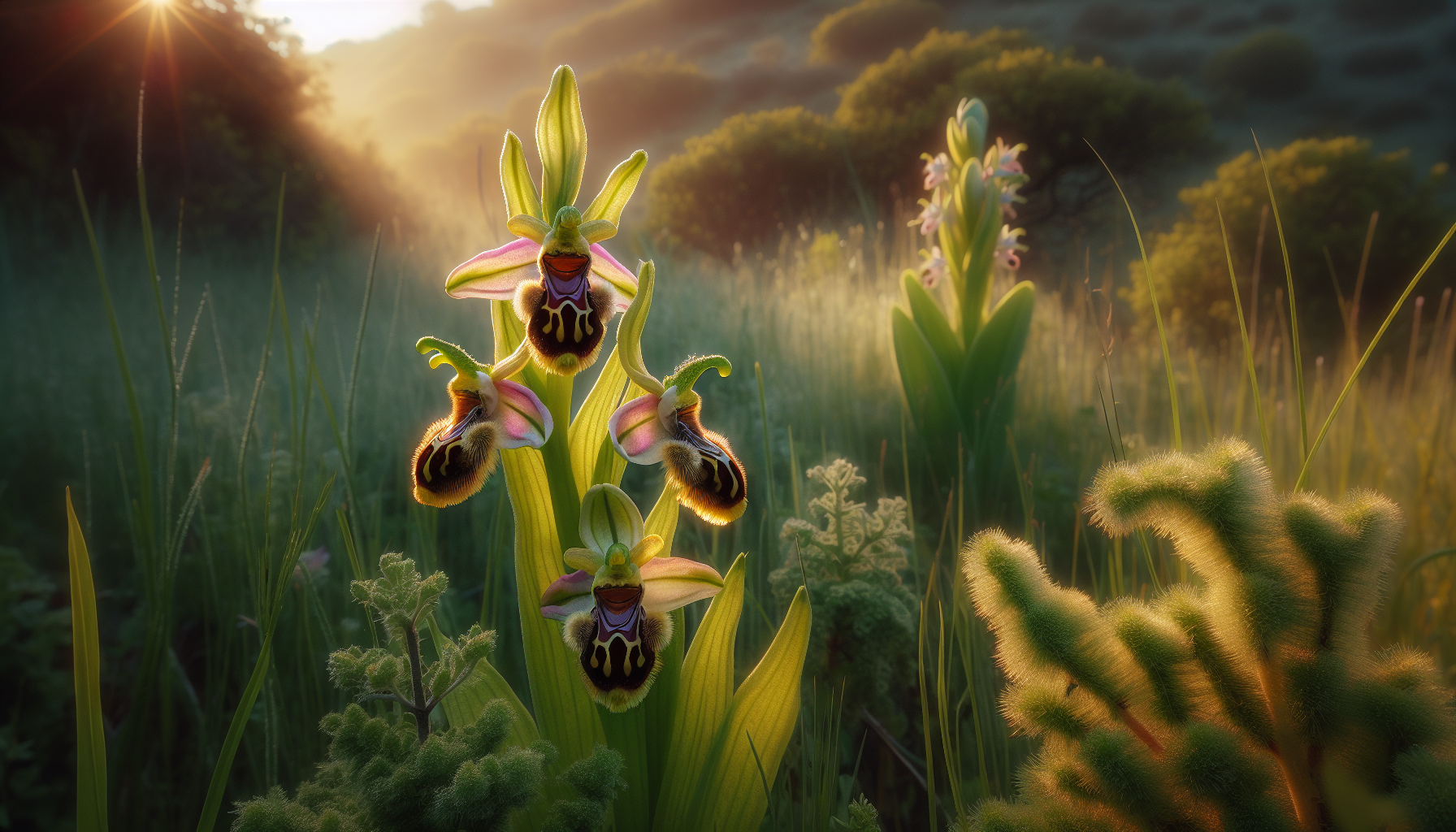
With the first breath of spring, the Sierra de San Pedro awakens from its winter slumber, revealing a landscape that seems to be taken from an impressionist painting. In the heart of Extremadura, this mountain range extends like a vast mosaic of holm oaks and cork oaks, interspersed with clearings where sunlight gently caresses the ground. It is here, in these radiant corners, that the bee orchid, _Ophrys apifera_, unfolds its floral magic.
The _Ophrys apifera_ is much more than just a simple flower; it is a masterpiece of nature. Its ability to imitate the appearance and scent of certain pollinating insects has fascinated scientists and curious onlookers alike. This mimicry is not an aesthetic whim, but a survival strategy that has evolved over millennia. By deceiving insects into attempting to copulate with its flowers, the orchid ensures pollination without the need to offer nectar as a reward.
The calcareous and nutrient-poor soils of the Sierra de San Pedro provide the ideal home for this species. Here, orchids find the perfect conditions to thrive: sunlight, moderate humidity, and limited competition for resources. The edges of paths and forest clearings are the preferred spots for their growth, where the interplay of light and shadow creates a favorable microclimate.
On a walk through the sierra, visitors can perceive the subtle aroma emanating from these orchids, a fragrance that, although imperceptible to many humans, is irresistible to insects. This floral deception is a fascinating example of the complexity of ecological interactions. The attracted insects not only pollinate the _Ophrys apifera_ but also visit other flowers, thus contributing to the biodiversity of the ecosystem.
For explorers wishing to witness this phenomenon in person, the Sierra de San Pedro offers a unique experience. Equipping oneself with a botanical magnifying glass is essential to appreciate the intricate details of the flowers, while binoculars allow for observing insect interactions without disturbing the environment. A camera with a macro lens becomes an ally in capturing the ephemeral beauty of these orchids.
The weather in March can be capricious, alternating between sunny days and sudden rains. Therefore, it is advisable to dress in layers and wear sturdy footwear to traverse the winding paths of the sierra. These trails not only lead to the orchids but also reveal the rich fauna of the area, from the majestic flight of eagles to the stealthy movements of wild boars.
In the silence of the sierra, broken only by the songs of birds and the whisper of the wind among the leaves, one can feel the intimate connection between all elements of the ecosystem. The _Ophrys apifera_ is an emblem of the Sierra de San Pedro, a testament to the complexity and beauty of the natural world. Its presence in the Extremaduran landscape not only enriches the visual environment but also offers an invaluable field of study for scientists and a delight for nature lovers.
Each visit to the sierra is an opportunity to rediscover the harmony of nature, where every flower, every insect, and every tree plays a role in the vast tapestry of life. In a corner of Extremadura, nature continues its course, weaving stories of survival and beauty that intertwine with time and space.
The Sierra de San Pedro, beyond its orchids, is a refuge for wildlife. In its skies, eagles soar majestically, while on the ground, wild boars and deer move cautiously. This diverse environment is fundamental for the bee orchid, as it relies on a balanced ecosystem to thrive. The forest clearings, where sunlight gently penetrates, are essential for its growth, providing the perfect microclimate that these orchids need.
The landscape of the Sierra de San Pedro is a testament to the harmonious interaction between flora and fauna. The holm oaks and cork oaks not only provide shade and protection but also contribute to the formation of the calcareous soil that is so vital for the _Ophrys apifera_. In this environment, every element plays a crucial role, from the smallest insect to the robust trees that dominate the horizon.
For those seeking a deeper connection with nature, the Sierra de San Pedro offers more than just a visual spectacle. It is a place where time seems to stand still, allowing visitors to immerse themselves in the serenity of the surroundings. Observing the _Ophrys apifera_ is just one of the many experiences this sierra has to offer. Its trails invite exploration, revealing nature's secrets at every step.
Spring in the Sierra de San Pedro is a reminder of renewal and the endless cycle of life. Here, the bee orchid not only blooms but also symbolizes the resilience and adaptability of nature. In a constantly changing world, the _Ophrys apifera_ remains a beacon of stability and beauty, a reminder that nature always finds a way to flourish.