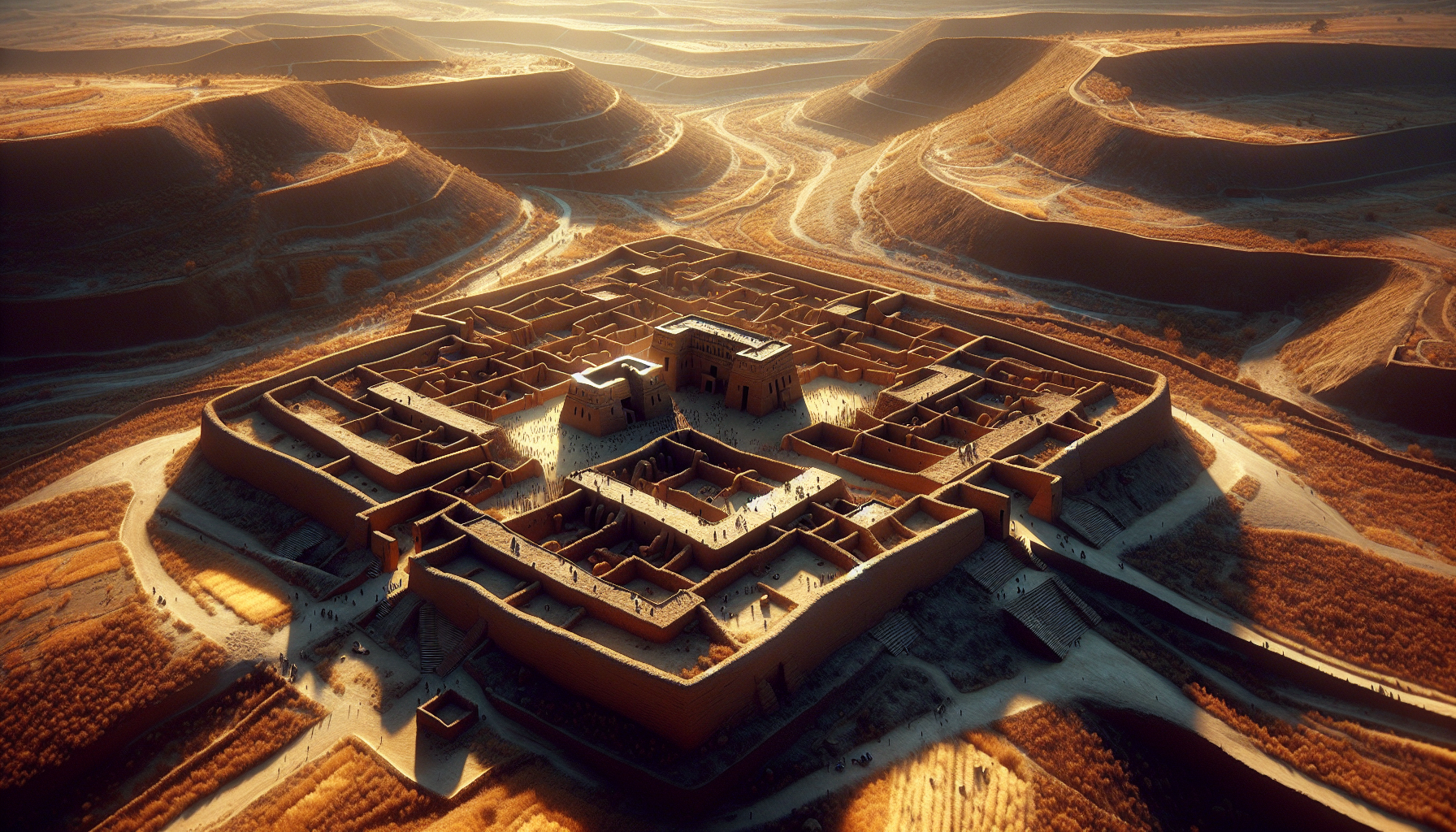
In the La Serena plateau, in the province of Badajoz, the enigmatic Cancho Roano site emerges, a Tartessian sanctuary that has fascinated archaeologists and visitors since its discovery in 1978. This site, hidden among the rolling landscape and vast stretches of land, offers a unique insight into the rituals and social organization of the Tartessians, a civilization that flourished between the 7th and 4th centuries BC in the southwest of the Iberian Peninsula.
Excavations have revealed a ceremonial complex surrounded by a defensive ditch, with adobe structures set on stone bases. Archaeologists have meticulously worked, unearthing each layer of history that time has buried. The dry and warm air of the region, along with the silence that envelops the place, seems to whisper stories of a distant past.
The Tartessian culture, linked to the legendary city of Tartessos, is recognized as one of the first civilizations with its own identity on the Iberian Peninsula. Located in the triangle that encompasses parts of Andalusia and Extremadura, Tartessos is famous for its wealth in precious metals and its interaction with the Phoenicians. Cancho Roano, on the periphery of this kingdom, may have been a node of exchange and worship.
Research has uncovered material remains, such as ceramics and metal tools, that reflect a complex system of beliefs and religious practices. At the heart of the sanctuary lies a central altar, where ritual sacrifices were likely performed, probably linked to fertility cults. The presence of jewelry and other prestige objects suggests that Cancho Roano was not only a religious center but also an epicenter of economic and political power.
The location of Cancho Roano in a plateau, near watercourses and fertile lands, underscores the importance of the natural environment in Tartessian religious practices. The relationship with the landscape and natural resources was fundamental for a civilization that depended on agriculture and trade. This connection is reflected in the fertility rituals believed to have taken place at the sanctuary.
Today, Cancho Roano is accessible to the public, managed by the Junta de Extremadura. About 10 kilometers from Zalamea de la Serena, it can be easily reached by car via the EX-104 road. Visitors can explore the ruins of the sanctuary, preserved under a structure that replicates its original layout. An interpretation center provides detailed information about the findings and the significance of the site.
The visit allows one to appreciate the architecture and layout of the sanctuary and understand its relevance in Tartessian culture. Through informative panels and guided tours, one can delve deeper into the knowledge of the religious and social practices of this fascinating civilization. The surrounding natural environment offers an ideal setting to reflect on the relationship between the Tartessians and their environment.
The Cancho Roano site remains a fascinating enigma. As one of the few discovered Tartessian sanctuaries, it provides invaluable insight into a civilization that, although vanished, left an indelible mark on the history of the Iberian Peninsula. As research progresses, Cancho Roano not only enriches our understanding of the past but also highlights the importance of preserving our cultural heritage.
The landscape surrounding Cancho Roano, with its gentle hills and open skies, seems unchanging, yet it has witnessed countless changes over the centuries. The fields that today are cultivated with wheat and barley may once have been traversed by the Tartessians, carrying their products to market or participating in ceremonies honoring their gods.
As the sun sets over the plateau, casting long shadows over the ruins, one cannot help but feel a connection to those who lived here so many centuries ago. The wind that blows through the stones seems to carry echoes of ancient voices, whispering secrets that are still waiting to be discovered.
With each visit to Cancho Roano, there is an opportunity to discover something new. Whether it is a new interpretation of a found artifact or a personal reflection on the significance of this place in the vast history of humanity. Cancho Roano is more than an archaeological site; it is a bridge to a past that remains alive in the collective memory of Extremadura.